
Deep Tunnel Sewerage System
Build time:
2017 - 2025
Location:
Singapore
Client:
Singapore's National Water Agency
Deep Tunnel Sewerage System
The Deep Tunnel Sewerage System (DTSS) in Singapore demonstrates how advanced technologies and innovative approaches can be used to successfully meet the increasing challenges of water and wastewater management with a growing population in densely populated urban areas.
The DTSS consists of a network of deep tunnels, main collectors that collect the wastewater from the secondary collectors and hydraulic drop structures that supply the water to the transport collectors in a controlled manner. At the ends of the transport collectors there are pump shafts around 80 m deep, which discharge the wastewater into three centralized sewage and water treatment plants. The construction of the DTSS network was planned in two phases over a period of 30 years and included the construction of around 100 km of deep transport collectors, 100 km of main collectors and numerous other underground pipe networks.
In phase 2, the deep tunnel was extended to connect the western part of Singapore and the sewer network. On September 25, 2017, PUB, Singapore's National Water Agency, awarded Ed. Züblin AG the design and build contract for sub-lot T-07 of the Deep Tunnel Sewerage System Phase 2 (DTSS2).
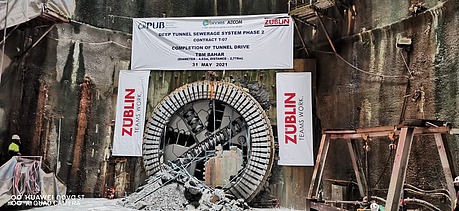
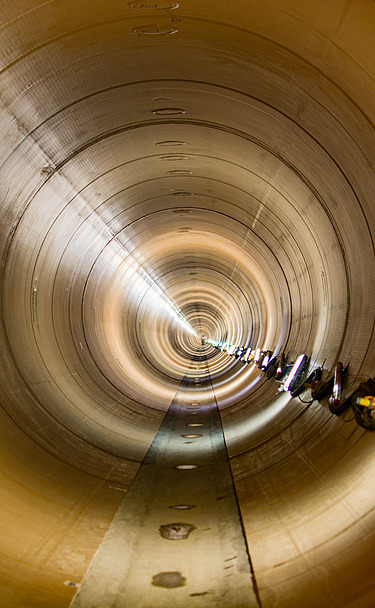
The scope of works included the construction of approximately 12 km of tunnels with diameters ranging from 3.5 m - 6.0 m and 14 shafts with depths of up to 65 m, which are either access shafts, hydraulic drop structures or shafts with isolation function. The contract also included the construction of an air jumper (AJ) and an odour control facility (OCF).
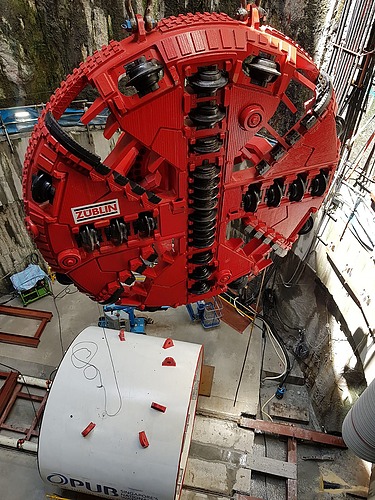
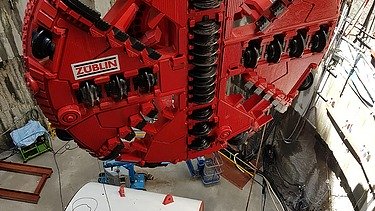
The temporary shafts with diameters of between 10 and 25 m were constructed using diaphragm walls, sheet pile walls, in-situ concrete construction methods and the construction of secant bored pile walls. Four Mixshield tunnel boring machines (slurry method) were used for the construction of the wastewater tunnels with diameters of 5 m and 7.5 m and a total length of 12 km. The primary tunnel lining was mainly made of steel fiber-reinforced tubbings, which were manufactured by the Züblin precast plant in Malaysia.
A concrete resistant against microbiologically influenced corrosion (MIC) was developed and used for the production of the tunnel lining and shaft structures. In the tunnels, this MIC-resistant concrete was also combined with an acid-resistant HDPE protective layer to ensure the planned service life of 100 years.
Construction of DTSS Phase 2 is expected to be completed in 2026. Singapore will then have a modern wastewater system, enabling it to increase its fresh water self-sufficiency to around 60%.
-
-