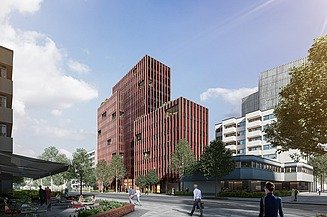
Exterior view of the CARL wooden high-rise in the evening at sunset
Exterior view of the CARL wooden high-rise in the evening at sunset © Christoph Zepelin Fotografie

CARL Timber Hybrid High-Rise

Location: 
Pforzheim

Build time: 
10/2021 - 9/2024

Client: 
Arlinger Baugenossenschaft eG

Back to Projects

CARL Timber Hybrid High-Rise

With the CARL timber high-rise in Pforzheim, ZÜBLIN is setting new standards in sustainable construction. Innovative solutions have created an impressive landmark at the western entrance to the city.

In June 2021, the Karlsruhe office was awarded the contract by Arlinger Baugenossenschaft eG for the turnkey construction of the "CARL" timber high-rise building project in Pforzheim, including outdoor facilities and execution planning. The aim was to create a striking landmark at the western entrance to the city, with the implementation of the timber façade in particular posing major challenges under strict fire protection requirements.

Ensemble CARL: Building structure and use

The ensemble comprises the CARL timber-hybrid high-rise building (Building 1) and two conventionally constructed longitudinal buildings (Buildings 2 and 3).

  • Building 1: 14 storeys, on the first floor an entrance area and a bakery with café, above 37 apartments.
  • Building 2: 6 floors, daycare center on the ground and 1st floor, 24 apartments above.
  • House 3: 4 storeys, technical and cellar storage rooms on the first floor, 12 apartments above.

All buildings meet the KfW 55-EE standard and share a basement with underground parking (73 parking spaces, all with electric charging stations). Buildings 2 and 3 have photovoltaic systems whose electricity benefits the tenants via a tenant electricity model. The upper floors of buildings 2 and 3 are accessed via arcades and are barrier-free thanks to external elevators.

Exterior view evening extension © Christoph Zepelin Fotografie

Close cooperation for future-oriented solutions

As part of planning phase 5, the implementation planning, special solutions had to be developed and coordinated with all project participants and authorities due to ambiguous regulations for a timber high-rise building. Thanks to the comprehensive and solution-oriented cooperation, all planning challenges were overcome.

Gliding upwards like a tower

The core of the timber high-rise building was constructed from in-situ concrete using the slipform method from the basement to the roof ceiling up to a total height of approx. 48 meters. As fire protection plays a special role in a timber hybrid high-rise, the core had to be made of concrete. It also serves to provide access to the floors and contains a safety stairwell and two elevators, one of which is designed as a fire department elevator.
It took a total of two weeks to construct the core with all the interior walls. The ceilings and stairs were then installed in the stairwell core, meaning that the concrete work was almost complete when work began on the residential floors.

Special elements for "CARL"

In the "CARL", the ceilings of the residential floors are timber hybrid ceilings. This means that they consist of 10 centimeter cross-laminated timber panels and 12 centimeters of concrete.
The exterior walls were designed as prefabricated timber frame elements and delivered just-in-time, so that the space required for intermediate storage could be reduced to a minimum.
Due to the high loads on the lower floors, beech columns were integrated into the exterior wall elements, as they have a very high load-bearing capacity. This posed the challenge that the wall elements had to be positioned so precisely during assembly that all of the supports integrated into the wall elements had to be exactly on top of each other.
The exterior timber façade of the "CARL" is very distinctive. Once the wall elements and windows had been installed, it was constructed as a curtain-type elemental timber façade. For logistical reasons, the façade elements were already temporarily stored on the floors during the shell construction work, so that subsequent transportation to the 14 upper floors was no longer necessary.

Fire protection as a safety guarantor

Fire protection played a central role in the timber hybrid high-rise building, as a safe concept had to be developed that met all requirements and preserved the special features of the building project. For example, a "brim" of visible precast concrete solutions was built between the storeys.
As a result, the façade meets the fire protection requirements for fire flashover from storey to storey and a sustainable, weather-resistant solution was found.
The entire timber high-rise was equipped with a fire alarm system. The access core contains a pressurized smoke system and a wet extinguishing water pipe with two extraction points per storey.

The strength of the Group

The timber construction work, including the façade, was carried out internally by ZÜBLIN Timber. The close cooperation enabled the development of project-specific solutions as well as the use of new technologies and access to the Group's own expertise.
The complexity and innovative nature of the project to construct a high-rise building in timber generated a great deal of interest from the public and experts. Numerous information events organized by the client and visits to universities were also supervised by the project team.

The project is aiming for DGNB "Sustainable Building Site" certification from the German Sustainable Building Council.

  • Characteristics
    • Plot area (GF): 5,020 m²
    • Gross cubic capacity (BRI): 46,185 m³
    • Gross floor area (GFA): 13,393 m²
    • Building 1 above ground (timber high-rise): 14 storeys
    • Above ground House 2: 6 storeys
    • Above ground House 3: 4 storeys
    • Underground: 1 storey
  • Construction time
    • Shell construction work from 13.10.2021 to 08.03.2023
    • Expansion from 02.2023 to 09.2024
    • Completion 09.2024
  • Construction site regular operation
    • Monday to Friday 07:00 to 18:00
    • Saturday 07:00 to 15:00
    • There is generally no work on Sundays and public holidays.

Certified by the German Sustainable Building Council (DGNB)

Ed. Züblin AG is pursuing several goals with this project: A sustainable construction site organisation, the conservation of resources as well as the minimisation of emissions, responsibility for the health and well-being of the builders, the cultivation of good neighbourliness and, of course, high-quality construction. For this, Ed. Züblin AG was the first company to be recognised by the German Sustainable Building Council (DGNB).

Here you can find more information about the DGNB system for sustainable construction sites: https://www.dgnb.de/en/certification/buildings/construction-site

Selected measures in the project

  • Measures to prevent pollution from the construction site

    The project is in a central, inner-city location, so efforts are being made to avoid or reduce the impact of the construction site as much as possible. The concepts for noise and dust avoidance and the protection of soil and groundwater on the construction site are key areas of action. There are also concepts for waste avoidance and an environmentally and resident-oriented logistics concept.

  • Saving resources and reducing emissions through LEAN Construction

    Through the consistent use of process planning, the ongoing construction work is synchronized and adapted to the planning specifications. This enables stable and structured work. This is accompanied by an increase in quality through efficient processes. This prevents waste.
    Another method is the 5S method for order and cleanliness on the construction site.

  • Use of (semi-)finished parts

    (Semi-)prefabricated elements (cavity walls, filigree slabs and stairs) are used in the project. In addition to shortening the construction time, this also reduces the amount of waste generated by the prefabricated construction elements.

  • Building with local wood

    The use of locally grown wood not only saves tons of concrete but also saves on delivery routes.

  • Energy management in construction

    Preliminary investigations of the individual construction processes with regard to the most energy-saving development possible. In particular, the focus here is on optimizing process durations.

  • Construction site logistics

    The just-in-time (JiT) concept ensures targeted and timely coordination of material deliveries to the construction site. The construction products are only transported to the right place at the right time and in the right quantity when they are actually needed. This allows both the number of transports to be reduced and the storage of materials on the construction site to be minimized or completely avoided.

  • Waste management

    An effective waste management system will be set up for the project. Targeted waste sorting and separation will take place on the construction site. This ensures that the resulting construction waste is properly disposed of and/or recycled.

  • Sustainability training

    Promoting education and training for all project participants to raise awareness of sustainability.

  • Promoting health and well-being

    Promotion of a healthy working environment and a pleasant indoor climate through suitable measures such as regular cleaning and ventilation.

  • Compliance with environmental protection legislation

    Monitoring and compliance with applicable environmental protection laws and regulations.

  • Regional construction partners

    Regional companies are involved in the provision of services. This ensures a partnership-based cooperation and synergy effects from existing project knowledge can be utilized.

Certification contact person Alexander Houy
Project contact Michael Jäger
Construction site address Carl-Hölzle-Strasse 3 - 7a
75179 Pforzheim

Phone +49 721 6204-290
ZÜBLIN Subdivision Karlsruhe
Assistant to the Unit Manager SFB
Download Press release
Link DGNB: Certification