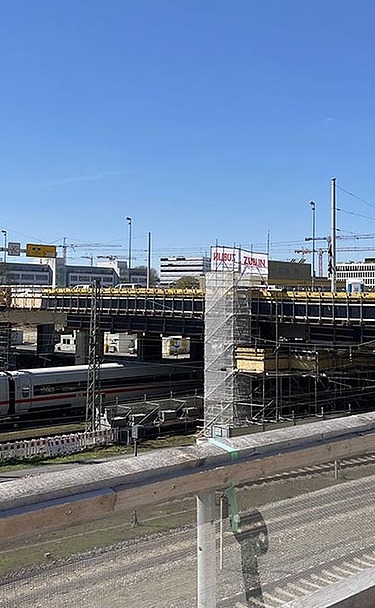

Modernisation of Montpellier Bridge
Location:
Heidelberg
Completion:
2025

Modernisation of Montpellier Bridge, Heidelberg
Location Speyerer Str. in Heidelberg
Extensive repair and reinforcement measures are to be carried out to eliminate the damage identified and the recognizable causes of damage to the Montpellier Bridge, thus upgrading the structure in terms of stability, traffic safety and durability.
The aim of the construction project is to preserve the existing structure through technical engineering services and to extend the maximum service life of the bridge to around 70 years.
The project is aiming for DGNB "Sustainable Construction Site" certification from the German Sustainable Building Council.
-
Characteristics
- Bridge type: Prestressed concrete bridge
- Year of construction: 1974 - 1976
- Bridge area: 11,700 m²
- Bridge length (main bridge): 219.3 m (east) / 230.5 m (west)
- Bridge width (main bridge): 37,05 m
- Bridge structure: 4 substructures
-
Construction time
- Start December 2022
- Completion September 2025
-
Construction site regular operation
- Monday to Friday 07:00 to 18:00
- There is generally no work on Saturdays, Sundays and public holidays.
Certified by the German Sustainable Building Council (DGNB)
Ed. Züblin AG is pursuing several goals with this project: A sustainable construction site organisation, the conservation of resources as well as the minimisation of emissions, responsibility for the health and well-being of the builders, the cultivation of good neighbourliness and, of course, high-quality construction. For this, Ed. Züblin AG was the first company to be recognised by the German Sustainable Building Council (DGNB).
You can find more information about the DGNB system for sustainable construction sites here: https://www.dgnb.de/en/certification/buildings/construction-site
Selected measures in the project
-
Low-dust renovation through the use of high-pressure water jets
The steel reinforcement at damaged areas is exposed using a high-pressure water jetting process (HPW jetting). This is followed by an assessment of the extent of the damage and refurbishment with new concrete material. HPW blasting is one of the low-dust renovation methods, as the concrete dust produced during concrete removal is bound by the water. The resulting waste water is collected and pumped into a collecting basin. The wastewater is then subjected to sedimentation and neutralization before being discharged into the regional wastewater system.
-
Scaffolding enclosure & mobile enclosure for HDW work
To reduce dust and noise emissions, the outer scaffolding around the Montpellier Bridge is enclosed. Mobile enclosures are also provided for HDW work.
-
Mobility on the construction site with e-bikes
During the tendering process, the client provided two e-bikes to ensure that the client could carry out site inspections and travel quickly to the construction site.
-
Waste reduction through prefabricated bulk containers for coating materials
Due to the large-scale bridge, large containers were requested and ordered from the supplier when ordering coating materials in order to reduce the amount of packaging.
-
Resident-oriented logistics concept
Storage areas are primarily located underneath the bridge. In order to ensure trouble-free material deliveries to the construction site, a construction road was planned for the renovation project during the first construction phase. This will allow access to the underside of the bridge, enabling logistics deliveries away from the local neighborhood.
| Certification contact person | Heinz Müller |
| Project contact | Olaf Humburg |
| Construction site address | Speyerer Str. 69115 Heidelberg |
| Download | Press release |
| Link | DGNB: Certification heidelberg.de - Modernization Montpellier Bridge |