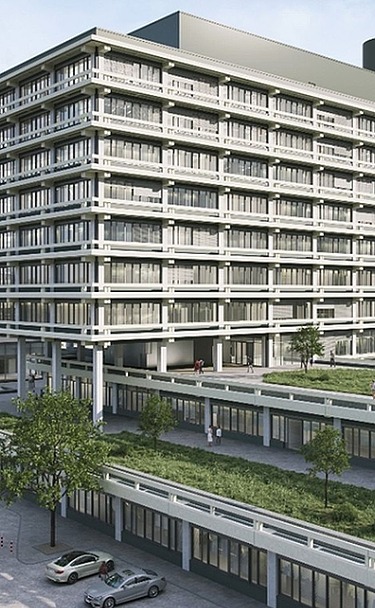

NA complex of the Ruhr University Bochum
Location:
Bochum
Completion:
2028

NA complex of the Ruhr University Bochum
Location Universitätsstr. 150 in Bochum
The new replacement building NA-Complex Ruhr-University Bochum is the implementation planning and turnkey construction of the new replacement building NA at the Ruhr-University Bochum including outdoor facilities.
The NA building complex consists of the 13-storey NA high-rise building with adjoining low-rise buildings (up to 6 storeys high) and a large cantilevered lecture hall building. In addition to various offices, the building also houses laboratories with complex laboratory technology, a clean room and other lecture theaters. There is also a cafeteria, service areas and a library in the building. Another special feature of the construction work is the preservation of the existing architectural and design structure of the entire university campus.
The project is aiming for DGNB "Sustainable Building Site" certification from the German Sustainable Building Council.
-
Characteristics
- Plot area (GF): 11,820 m²
- Gross cubic capacity (BRI): 275,160 m³
- Gross floor area (GFA): 59,650 m²
- Above ground: 13 storeys
- Underground: 1 storey
-
Construction time
- Construction site equipment from 03/24 to 05/24
- Structural work from 09/24 to 05/26
- Building envelope from 09/25 to 09/26
- Expansion from 12/25 to 11/27
- Completion 11.02.2028
-
Construction site regular operation
- Monday to Friday 07:00 to 17:00
- Saturday 06:30 am to 2:00 pm
- There is generally no work on Sundays and public holidays.
Certified by the German Sustainable Building Council (DGNB)
Ed. Züblin AG is pursuing several goals with this project: A sustainable construction site organization, the conservation of resources as well as the minimization of emissions, responsibility for the health and well-being of the builders, the cultivation of good neighbourliness and, of course, high-quality construction. For this, Ed. Züblin AG was the first company to be recognized by the German Sustainable Building Council (DGNB).
You can find more information about the DGNB system for sustainable construction sites here: https://www.dgnb.de/en/certification/buildings/construction-site
Selected measures in the project
-
Digital concrete call-off
In order to be able to coordinate the concreting in the best possible way, the call-offs are made using a digital application. The delivery rates can be coordinated with the concrete pump, particularly for large-scale concreting, thus reducing the waiting times of the concrete mixers. Production times are optimized and noise emissions are reduced.
-
Saving resources and reducing emissions through LEAN Construction
The Lean Last Planner system is used for the shell construction work. This includes the continuous detailed planning of a daily forecast for the next three weeks (3-week forecast), as well as a weekly forecast every three months. Meetings are also held twice a week. Changes in the construction process can thus be incorporated directly so that they can be better controlled and carried out efficiently. As a result, reorders and new orders can be reduced.
-
Measures to prevent pollution from the construction site
The project is located on a large campus site, so the aim of the construction site is to minimize the impact on the university's students and employees as much as possible. Various measures are planned, which can be distinguished on the one hand by the selected construction methods and on the other hand by the organization of the processes.
-
Reduction in noise emissions and vibrations
In order to keep noise emissions and vibrations to a minimum, alternatives to the original construction methods were investigated. For example, the shocks, vibrations and noise emissions that would have been caused by the planned pulling of the shoring beams were reduced to a minimum by burning off the beams and leaving them in the ground.
-
Use of energy-efficient construction machinery
It is planned that all motorized equipment and machinery used on the construction site, e.g. earthmoving equipment, compressors, etc., with an output of over 75 kW will be documented and the EU level (energy efficiency class/EEK) they meet will be recorded to ensure that the most energy-efficient construction machinery possible is used.
-
Disposal logistics
The waste disposal concept provides for the respective subcontractor to dispose of its waste in floor collection stations. The waste disposal logistics company then takes over from these collection stations and removes this waste from the building to the waste disposal containers located on the construction site. This ensures that waste is disposed of according to type.
| Certification contact person | Kristina Pors |
| Project contact | Dirk Stille |
| Construction site address | Ruhr University Bochum Universitätsstr. 150 44801 Bochum Andrea Kosik Departmental Assistant Phone +49 231 950804 - 11 Züblin Subdivision NRW, Dortmund Unit |
| Download | Press release |
| Link | DGNB: Certification |