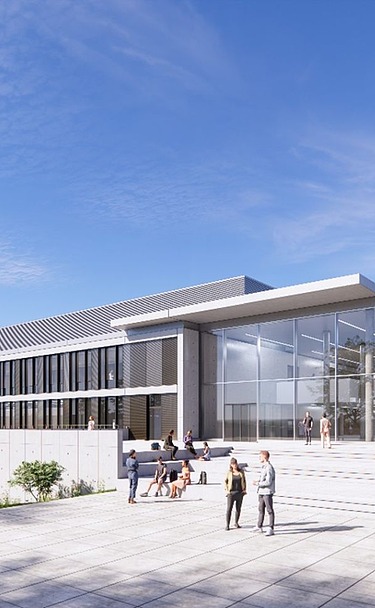

University Preclinical Center Regensburg
Location:
Regensburg
Completion:
2025

University Preclinical Center Regensburg
Location Am Biopark 12 in Regensburg
The property to be built on is located in the south of the city of Regensburg, between the old town/railway area and the BAB 3 highway on the grounds of the Regensburg university campus .
This is located on Galgenberg between Universitätsstraße and Galgenbergstraße.
The construction site for the new preclinical medicine building is located in the south-western part of the university, to the south of the faculty buildings of the western natural sciences, to which it is to be attached. In the course of clearing the construction site, the existing building of the biology department was dismantled. To the south, the construction site is bordered by the street 'Am Biopark'. The greenhouses of the Botanical Garden, which are still in operation, are located in front of this road. To the east, the central green axis of the campus with its views of Regensburg Cathedral provides a pedestrian route through the campus. To the west are the open spaces of the Botanical Gardens.
The new preclinical medicine building is designed in a ladder-like structure and consists of six two- to four-storey building sections that are connected in an east-west direction via a central two-storey hall. To the north, the building complex is attached directly to the existing structure of the western natural sciences, with which the access areas are shared. The so-called F-buildings (F0, F1 and F2) are located between the existing buildings to the north and the central hall. The G components (G1, G2 and G3) are located to the south of the hall, which is designated component FG. All components are connected to each other via a flat basement. In contrast to this, component F0 is only connected to the basement at certain points and is otherwise elevated as a deep courtyard. In a north-south direction, an accessible supply channel runs underneath components F0 and G1, which ensures the central infrastructural supply of the campus and remains unchanged. The supply channel divides the construction site into an eastern and a western area, which is why two construction site access roads are required.
The project is aiming for DGNB "Sustainable Construction Site" certification from the German Sustainable Building Council.
-
Characteristics
- Gross cubic capacity (BRI): 124,500 m³
- Gross floor area (GFA): 27,650 m²
- Above ground: 1-4 full storeys
- Underground: 1-2 full storeys
-
Construction time
- Construction site installation from 28.11.2023 - 15.12.2025
- Special civil engineering from 08.01.2024 - 03.07.2024
- Shell construction work from 04.03.2024 - 15.12.2025
-
Construction site regular operation
The core working hours on the construction site are as per the Ed. Züblin AG construction site regulations:
- Monday to Friday 07:00 to 17:00
- Saturday 07:00 am to 12:00 pm
- There is generally no work on Sundays and public holidays.
Certified by the German Sustainable Building Council (DGNB)
Ed. Züblin AG is pursuing several goals with this project: A sustainable construction site organization, the conservation of resources as well as the minimization of emissions, responsibility for the health and well-being of the builders, the cultivation of good neighbourliness and, of course, high-quality construction. For this, Ed. Züblin AG was the first company to be recognized by the German Sustainable Building Council (DGNB).
You can find more information about the DGNB system for sustainable construction sites here: https://www.dgnb.de/en/certification/buildings/construction-site
Selected measures in the project
-
Finished parts
The extensive use of prefabricated parts (beams and stairs) means that a shorter construction time can be achieved. The volume of waste is also reduced thanks to the prefabricated orders.
-
Formwork optimization
In close cooperation with the client, planners and the formwork supplier, the required material is planned in advance and optimized so that the individual elements can be used as often as possible. This results in a reduction in delivery routes, reduced space requirements on site and the minimization of additional building materials such as construction timber, which is otherwise often only used once.
-
Reinforcing steel
By purchasing and supplying prefabricated, i.e. pre-bent and cut-to-size reinforcement, both noise emissions and reinforcement waste can be largely avoided. Optimized deliveries also reduce the primary energy requirement.
-
Digital concrete call-off via local supplier
When selecting the concrete supplier, the focus was already on regionality so that delivery routes can be shortened and any waste can be almost completely avoided. In order to be able to coordinate the concreting in the best possible way, the call-offs are made using a digital application. The delivery quantities can be coordinated with the concrete pump, particularly for large-scale concreting operations, thus reducing the waiting times of the concrete mixers. Production times are optimized and noise emissions are reduced.
-
Saving resources and reducing emissions through LEAN Construction
As part of the lean approach, a production plan with call-off dates (e.g. insulation) was created. Construction production planning is detailed on a weekly basis and adapted to actual production progress. Changes in the construction process are constantly taken into account and just-in-time deliveries can be better implemented. Repeat orders and new orders due to late changes to the plan are avoided.
-
Measures to prevent pollution from the construction site
The project is being implemented in the vicinity of neighboring buildings, which have high demands in terms of construction site impacts due to the ongoing operation of highly sensitive research and teaching. The impact of the construction site will be avoided or reduced as far as possible by the selected methods. For example, low-vibration and low-noise foundation engineering methods were used for the foundations. This was a key aspect of the improvement in the alternative foundation concept proposed by Züblin. Contamination of construction roads and adjacent public traffic routes is cleaned every working day with a sweeper, including water spraying to prevent dust. Necessary grinding work is reduced to a minimum and only carried out with direct extraction.
-
CMC process
The CMC method from Menard GmbH was used as part of the special foundation engineering work, the foundation solution was optimized and the CO2 requirement of the construction project was reduced as a result. The process was selected taking into account the global warming potential (t eq CO2).
-
Energy management in construction
Construction operations studies and comparative considerations for the most energy-efficient project execution possible, such as the selection of a large concrete bucket to reduce the number of crane lifts, are being implemented.
| Certification contact person | Valerie Sartorius |
| Project contact | Christoph Kindsmüller |
| Construction site address | Am Biopark 12 93053 Regensburg Phone +49 941 4021-500 ZÜBLIN Bavaria Subdivision Regensburg unit |
| Download | Press release |
| Link | DGNB: Certification |