
LabCampus area AirportAcademy
Location:
Munich
Build time:
1Q/2020 - 2Q/2023
Client:
LabCampus GmbH (wholly owned subsidiary of Munich Airport)
LabCampus area AirportAcademy
ZÜBLIN designs two impressive office buildings for the AirportAcademy LabCampus site with a unique supporting structure.
Building concepts: LAB 48 and AirportAcademy
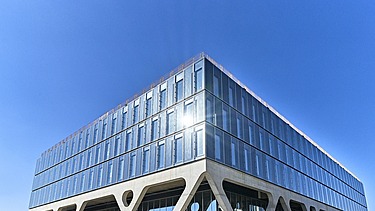
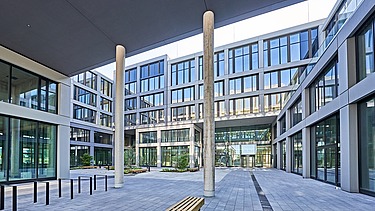
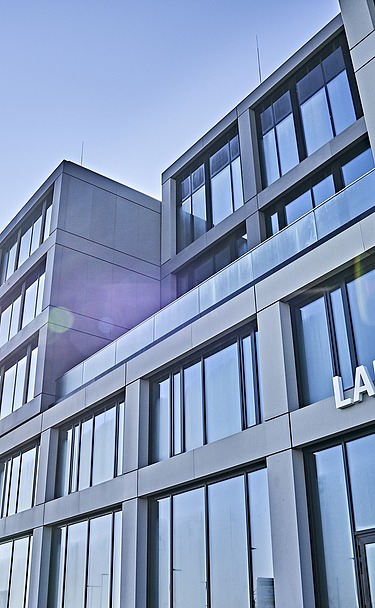
LAB 48, the first component of the LabCampus, was launched as a vision in February 2020 and took shape in 2021. The four-storey office building with an area of around 30,000 square meters reflects the innovative spirit of the LabCampus with its network character and flexible usage options. Generous window fronts and a multi-faceted façade give the building a lively appearance. The first floor serves as a meeting point and communication area for all users. The LabCampus is not only a place to work, but also a place to meet and exchange ideas.
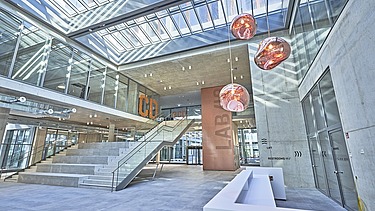
With the LAB 52 AirportAcademy, an impressive building was created parallel to LAB 48, which reflects the guiding principle of the LabCampus - "Connect. Create. Collaborate" in its architecture. The building, with a gross floor area of almost 14,400 square meters, offers space for spacious conference areas, seminar rooms with high-quality technical equipment and a lobby spanned by a glass roof. A central event area for up to 500 guests rounds off the offer.
Technical masterpieces: From concept to reality
The exterior structure of the AirportAcademy is characterized by a striking, two-storey concrete truss construction whose design was inspired by a bird's eye view of the runways at Munich Airport. The ZÜBLIN team in Bavaria erected this complex structure in just seven months. The challenge lay not only in the technical complexity of the project, but also in keeping to the tight schedule. Another technical masterpiece is the energy concept of the building complex. Here, ZÜBLIN fulfilled the tender criteria such as the installation of district heating, the installation of passive cooling via well systems, concrete core activation and the installation of cooling and heating ceilings. These sophisticated concepts contribute to the efficient use of energy and thus to the sustainable operation of the building complex. Concrete core activation, for example, uses the thermal mass of the building components to heat and cool the building, which both reduces energy consumption and increases comfort for users. This was one of the key tender criteria for the LabCampus and ZÜBLIN was able to impress with its extensive experience in this area.
Pioneering architecture
The successfully completed buildings contribute significantly to the design of the LabCampus, an innovation hub that optimally links the working and living environments of companies, research institutions and scale-ups on an area of around 26 hectares.
The projects not only demonstrate ZÜBLIN's expertise in the construction industry, but also the company's future-oriented approach to designing modern, sustainable working environments. Through its work at the LabCampus, ZÜBLIN has also gained valuable insights for future construction projects.
Further information on the LabCampus: www.labcampus.de