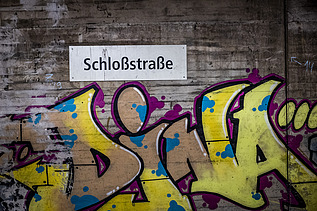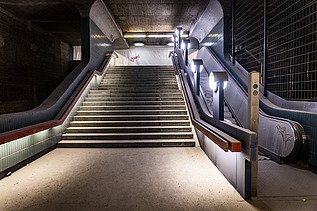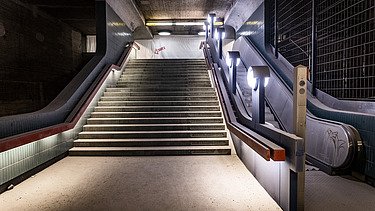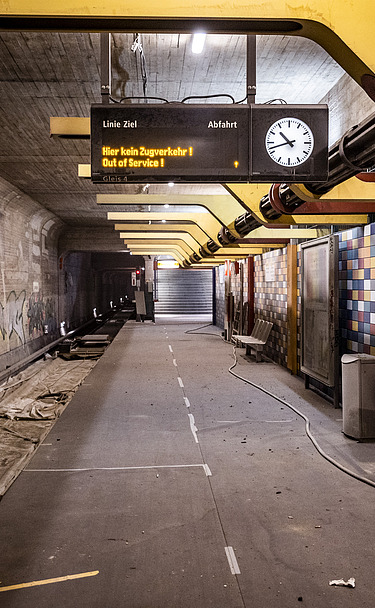
Photo of a subway stop with graffiti
Photo of a subway stop with graffiti © Uwe Hauth

Renovation of the Schlossstrasse subway station

Location: 
Berlin

Build time: 
05/2023 - 12/2023

Client: 
Berliner Verkehrsbetriebe BVG

Back to Projects

Renovation of the Schlossstrasse subway station

The station, built between 1971 and 1973, is located below Schloßstraße between Schildhornstraße and Zimmermannstraße. The station was opened on September 30, 1974 and was originally designed as a transfer point.

The end of May 2023 marked the start of the extensive refurbishment of the station in the Steglitz-Zehlendorf district by the TORKRET brand of ZÜBLIN Bauwerkserhaltung. A large part of the renovation work took place during the vacation period from 24.07.23 to 31.08.23, especially in the area of the two railroad levels. One particular challenge was that the material had to be transported exclusively by rail. A tight time window of 2 to 3 hours was available for this during the night shift.

Emissions savings and energy from 100% green electricity

Due to the available infrastructure and limited space in the tunnel network, only powerful electric compressors, which are rarely used on renovation sites, could be used to supply energy to the construction site. The use of these compressors enabled major savings to be made on fossil fuels. Due to their high connected load, two of these electric compressors have the power of four diesel compressors.

As the electricity provided by the client for the electric compressors also consists of 100% green electricity, no further emissions were produced for the energy supply of the renovation work. A good environmental balance.
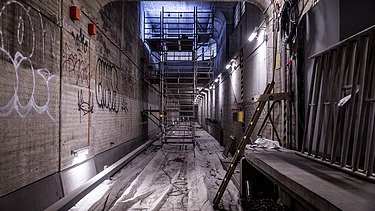
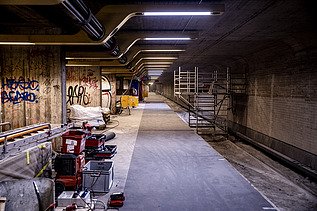
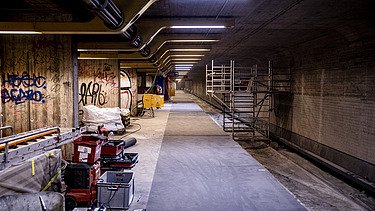
Photo of a scaffold in the track bed of the stop © Uwe Hauth

Dry ice blasting for gentle refurbishment

As an alternative to conventional sandblasting, dry ice was used for the most part in the renovation of the subway station, which is a gentler and less resource-intensive option. The use of the sandblasting process would have resulted in approx. 200-250 tons of sand, which would have had to be disposed of and sampled due to the existing impurities, for the blasting area of around 12,000 square meters including rebound material. Project-specific investigations and data from field reports have shown that the material requirement when using dry ice and some sand is comparatively low at only 12 tons.

When cleaning the surfaces with dry ice, the walls are bombarded with solid pellets. This removes the paint from graffiti and loose areas of concrete or mortar. This makes it easier to inspect damaged areas and make cracks more visible. Another advantage is that permanently installed pipes and cables can remain in place, as the dry ice does not cause any damage. The dry ice is delivered directly to the construction site in an insulated container and can be stored there for several days without an additional cooling system.
The only material that remains to be disposed of is the particles removed by blasting, as the dry ice quickly sublimates toCO2. The fallen solids are then extracted from the film laid out in the track bed. This reduces the amount of material that would otherwise have to be transported to the surface and disposed of at great expense.

For more extensive damage in the subway station, where the damage has already penetrated to the reinforcement, sandblasting is still required. The dry ice process proved to be a very suitable restoration method for this application. A positive conclusion can be drawn here, particularly due to the reduced amount of work, reduced costs and lowerCO2 emissions.