
The ZÜBLIN-House
Location:
Stuttgart
Build time:
1983 - 1984
The ZÜBLIN-House
The company headquarters in Stuttgart is an architectural highlight for employees and visitors alike. The striking office building combines visionary architecture, innovation and company history in one place.
Architecture that still impresses today
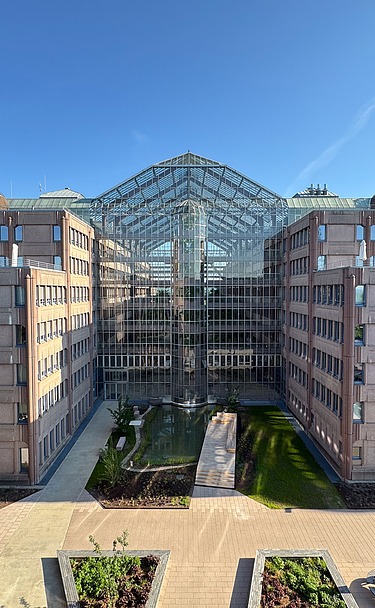
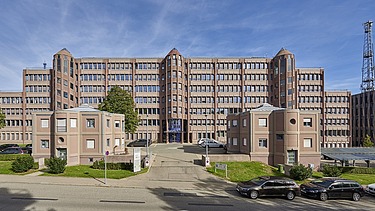
The ZÜBLIN House in Stuttgart was built between 1983 and 1984. Designed by Cologne architect and Pritzker Prize winner Prof. Gottfried Böhm, it was inaugurated on May 22, 1985. The building is characterized by its striking façade of shaped concrete elements with Rhine gravel and the unmistakable reddish colouring, which gives the building a warm yet powerful appearance. The façade was created from prefabricated, red-colored parapet panels with attached window mullions and darker load-bearing façade supports. Since the company was founded by Eduard Züblin, a pioneer of reinforced concrete construction, ZÜBLIN continuously developed the reinforced concrete construction method and had a special bond with the building material. Concrete and the latest precast technology were therefore the only suitable building materials for the ZÜBLIN House in Stuttgart. In 2009, the ZÜBLIN House in Stuttgart was added to the list of cultural monuments.
Layout and structure of the building
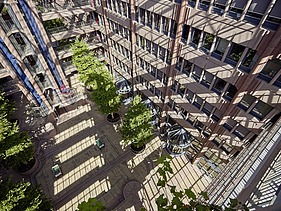
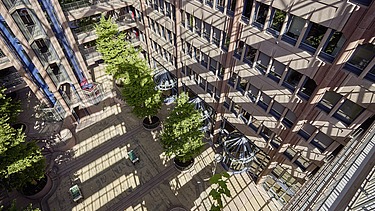
The 94-metre-long ZÜBLIN building consists of two seven-storey office wings that are 24 meters apart and connected by three walkways. Viewed from the outside, the building is divided by three tower-like core areas.
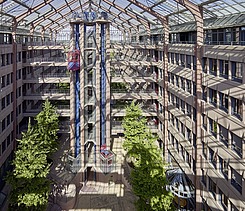
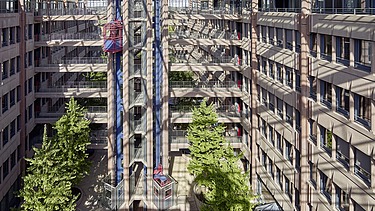
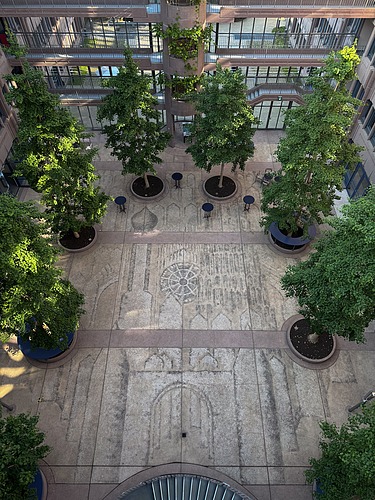
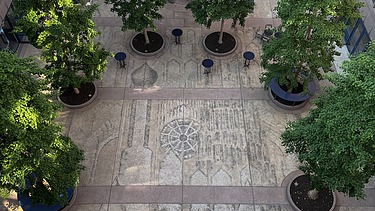
The heart of the building is the impressive, 60-metre-long and 25-metre-high atrium between the two wings. A saddle-shaped glass roof and a generous glass facade transform the inner courtyard into a light-flooded space - an ideal location for special events. The atrium is adorned with ginkgo trees - a living symbol of stability, growth and the future. At each end of the atrium, there are two artistic mosaics made of black marble stones on the floor. At the same time, the atrium makes a significant contribution to reducing the energy consumption of the ZÜBLIN building: through lower heating costs for the offices facing the inner courtyard and thanks to the heat pumps under the roof, which help to heat the building's water supply.
-
-
-
Architect Gottfried Böhm
The Cologne architect Gottfried Böhm and ZÜBLIN came together in the early 1980s when a new ZÜBLIN company headquarters was due to be built in Stuttgart. Gottfried Böhm, who had already made a name for himself with sacred and cultural buildings, was predestined for reinforced concrete construction. In particular, his handling of the malleable building material concrete in the realization of the Neviges pilgrimage church in North Rhine-Westphalia, which was built by ZÜBLIN between 1965 and 1967 and later renovated by ZÜBLIN, had earned him great renown in the industry. The unusual roof shape of the Neviges pilgrimage church resembles a monumental folded structure with exposed concrete surfaces.
The headquarters of Ed. Züblin AG
The ZÜBLIN building, together with the buildings Z zwo and Z3, which were added later, form the headquarters of Ed. Züblin AG, Central Technology and several specialist departments and subsidiaries. Around 1,200 employees of the Group work here.
However, the ZÜBLIN campus is not only exemplary in terms of architecture, but also in terms of sustainability: ZÜBLIN is the first and so far only company in Germany to receive a certificate from the German Sustainable Building Council (DGNB) for every building on its premises. The Stuttgart-based company received silver for Z-zwo in 2009, followed by gold for Z3 and bronze for the listed ZÜBLIN building in 2014. Following the completion of extensive renovation work on the ZÜBLIN House in 2017, which took around two years, the DGNB bronze rating was even upgraded to silver: Following the installation of a company-owned combined heat and power plant in 2012 to improve the building's energy efficiency, the window glazing was replaced to achieve better thermal insulation and a cooling system was installed.