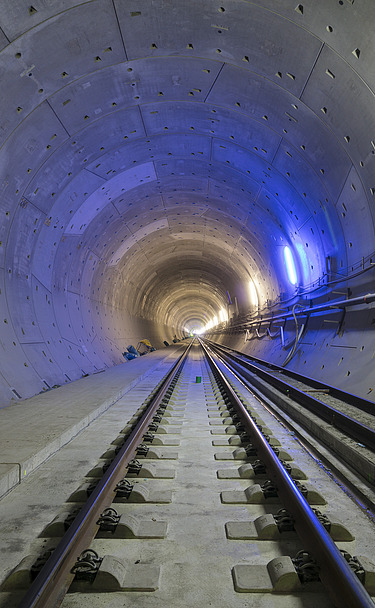

Tunnel Rastatt
Location:
Ötigheim, Germany
Client:
DB Infra GO AG Karlsruhe
Tunnel Rastatt
As part of the expansion and new construction of the Karlsruhe - Basel line, the new "Rastatt Tunnel" railroad tunnel is being built.
The tunnel with two single-track tubes has a total length of 4,270 m. Of this, 3,826 m for the east tube and 3,890 m for the west tube were constructed using the closed construction method with two TBMs (hydro shield with separation system) with a circular cross-section and a single-shell segmental lining d = 50 cm.
The drilling diameter of the machines was 10.97 m, the internal diameter of the completed tunnel 9.60 m. Of particular note is the undercutting of the Federbach FFH area under the protection of an icing roof created from the ground surface.
A total of around 710,000 m³ of excavated material was produced during the tunnel drive. The subsoil consists of groundwater-bearing Quaternary and Tertiary layers with predominantly Quaternary gravels and sands and subordinate Tertiary silts and clays.
9 connecting structures, so-called cross-passages, serve as escape routes or to connect to a supply and disposal shaft. They were excavated at 500 m intervals using shotcrete construction with icing to stabilize the surrounding subsoil. An inner shell with external sealing was then installed.
The open construction methods arranged at both ends of the tunnel are divided into north and south. The north section includes a groundwater basin with a length of 800 m and a 45 m long cut-and-cover tunnel. The south section comprises a groundwater basin with a length of 895 m, as well as cut-and-cover tunnels with a length of 382 m for the east tunnel and 336 m for the west tunnel. In principle, the structures were built using the cut-and-cover method with a water-impermeable excavation pit enclosure and a back-anchored underwater concrete base.
A supply shaft with a diameter of 3.60 m and a depth of 30 m was constructed from circularly arranged overlapping bored piles (D = 1.50 m) with an in-situ concrete inner shell. The shaft is used for drainage at the lowest point of the tunnel and is equipped with a lifting system and an operations building for this purpose.
A railroad bridge and a service road overpass complete the scope of work carried out.
Client: DB Infra GO AG Karlsruhe
Contractor: Arbeitsgemeinschaft
Ed. Züblin AG, Dir. IU-Tunnelbau
HOCHTIEF Solutions AG
