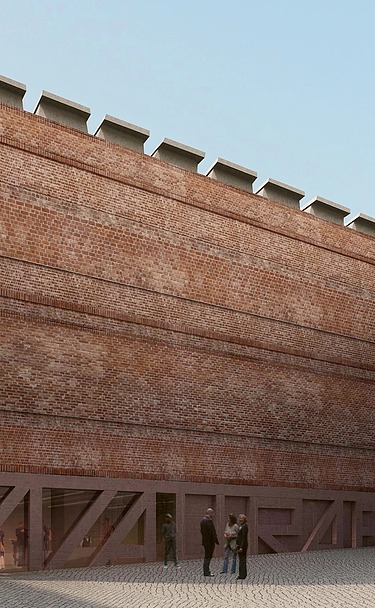

Wallraf-Richartz-Museum & Fondation Corboud
Location:
Cologne
Build time:
2/2025 - 1/2028
Client:
City of Cologne

Extension of the Wallraf-Richartz-Museum in Cologne
Ed. Züblin AG, North Rhine-Westphalia Directorate, Cologne Division, is building the extension to the Wallraf-Richartz-Museum & Fondation Corboud on behalf of the City of Cologne.
The extension, designed by Swiss architects Christ & Gantenbein, will be built in Cologne's old town and connected to the museum's existing building by an underground connecting structure. This will create around 5,500 square meters of gross floor area for the museum as well as around 900 square meters of high-quality municipal administration space, which will be created in the new block development.
The highlights of the project include the southern corner of the building, which is supported by a massive steel intercepting girder due to the subway tunnels below. The building structure is supported by cantilevers over a Roman city wall and an ancient culvert structure, so that these historical documents remain virtually intact in the ground.
Inside, concrete ceilings up to 11 meters in height impress with the highest design standards, which are realized in a sophisticated composite system of prefabricated and in-situ concrete with concealed integrated building technology. The façade picks up on the archaeological layers of the city with an elaborately reliefed brick structure in combination with a lettering base made of pigmented exposed concrete.
The underground connecting corridor under Martinstrasse links the new extension with the existing building - a masterpiece of modern building culture in the heart of Cologne's old town.
One of the aims of the work is to create the optimal accommodation and presentation of the Corboud Collection. The Swiss Gerhard J. Corboud and his wife Marisol, a native of Cologne, lived in Cologne for a long time. In 2001, they left a collection of 170 paintings to the City of Cologne "as a perpetual loan" for the benefit of the Wallraf-Richartz-Museum and thus placed it in the care of the City of Cologne.
The project is aiming for DGNB "Sustainable Building Site" certification from the German Sustainable Building Council.
-
Characteristics
- Gross floor area (GFA): 5,500 m²
- Storeys (above ground): 3
- Storeys (underground): 2
-
Construction time
- Construction site equipment from 10/25 to 06/28
- Structural work from 02/26 to 08/27
- Building envelope from 06/27 to 12/27
- Finishing work from 01/27 to 02/28
- Completion expected in June 2028
-
Construction site regular operation
Monday to Friday 07:00 to 18:30
Saturday 07:00 to 14:30
There is generally no work on Sundays and public holidays
Certified by the German Sustainable Building Council (DGNB)
Ed. Züblin AG is pursuing several goals with this project: A sustainable construction site organization, the conservation of resources as well as the minimization of emissions, responsibility for the health and well-being of the builders, the cultivation of good neighbourliness and, of course, high-quality construction. For this, Ed. Züblin AG was the first company to be recognized by the German Sustainable Building Council (DGNB).
Here you can find more information about the DGNB system for sustainable construction sites: https://www.dgnb-system.de/de/gebaeude/baustelle/
Selected measures in the project
-
Saving resources and reducing emissions through LEAN Construction
As part of the lean approach, a production plan with call-off dates (e.g. insulation) was created. Construction production planning is detailed on a weekly basis and adapted to actual production progress. Changes in the construction process are constantly taken into account and just-in-time deliveries can be better implemented. Repeat orders and new orders due to late changes to the plan are avoided.
-
Measures to prevent pollution from the construction site
The project is in a central, inner-city location, so efforts are being made to avoid or reduce the impact of the construction site as much as possible. The concepts for noise and dust avoidance and the protection of soil and groundwater on the construction site are key areas of action. There are also concepts for waste avoidance and an environmentally and resident-oriented logistics concept.
-
Digital concrete call-off / digital steel call-offIn order to coordinate the concreting work in the best possible way, call-offs are made using a digital application. Production times are optimized and noise emissions are reduced.
-
CommunicationInforming the publicInforming residents and local businessesInformation platform
| Certification contact person | Kristina Pors |
| Project contact | Eduard Manz |
| Construction site address | Marsplatz 10 50679 Cologne Claudia Palten Area AssistantPhone ZÜBLIN Subdivision NRW Unit Cologne |
| Download | Press release |
| Links | DGNB certification |