
US Hospital Weilerbach
Build time:
from 9/2022
Location:
Weilerbach
Client:
Federal Building Administration
US Hospital Weilerbach
Construction of the largest U.S. hospital outside of the United States in Weilerbach in the West Palatinate.
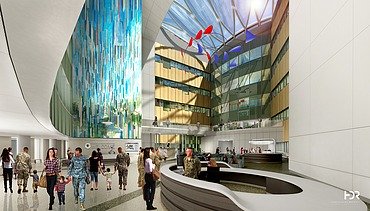
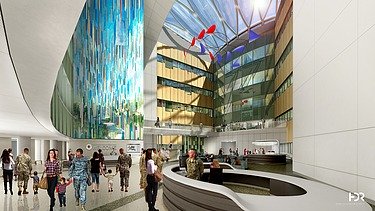
In a joint venture with Gilbane Germany GmbH, ZÜBLIN is planning and realizing the largest U.S. hospital outside of the United States in Weilerbach, in the immediate vicinity of Ramstein Air Base. The new building will replace the military hospital in Landstuhl, which was built in 1953, and the air force clinic at Ramstein Air Base. A state-of-the-art hospital is planned on an area of around 90,000 square meters with nine operating theatres and 120 examination rooms. Once completed, around 2,500 people will work in the new hospital building.
The various façades are a particular highlight of the project. The main façade is a glass wall, which is characterized by an undulating floor plan with polygonal grids and special triple solar control insulating glazing. These panes of glass are each printed differently and assembled in such a way that they ultimately create a camouflage pattern characteristic of the military. The rear fassade of the building is composed of fiber cement panels in three different shades, which also resemble the camouflage pattern. Other impressive façade elements include the connecting corridors between the individual sections of the building, designed as post-and-beam constructions, as well as large natural stone surfaces in front of and above the shop window façades on the first floor and on the chapel.
The new hospital will be the central point of contact for around 200,000 members of the US military, civilian employees of the Department of Defense and other authorities as well as their families. It will provide primary care, specialized medical care, inpatient stays and outpatient treatment. In addition, it serves as the primary treatment and evacuation center for wounded U.S. military personnel, civilians and external personnel working in Central and Southwest Asia, Europe and Africa. With its modern infrastructure, the hospital supports seven U.S. military units, making it a critical pillar of medical care.
-


-


-